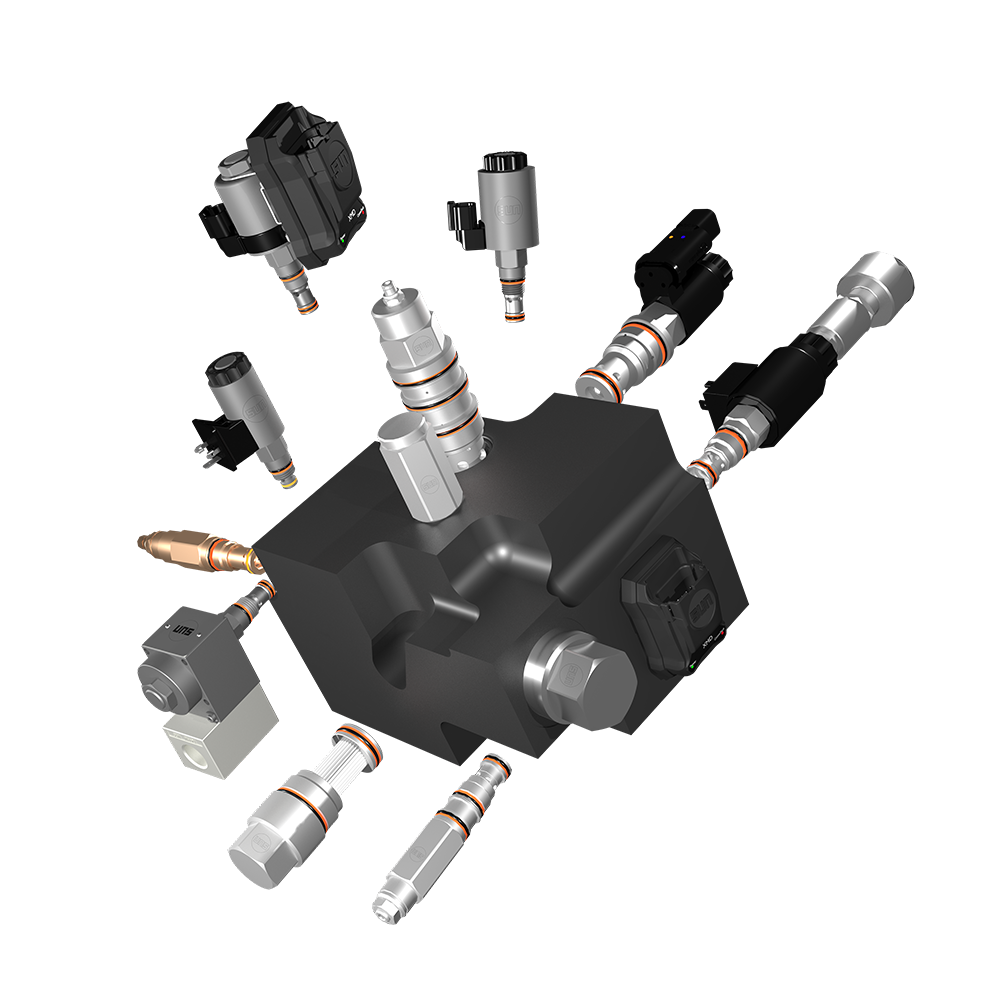
Designing hydraulic manifolds is our core expertise – we’ve made thousands over the years. A well-executed design always starts with the right methodology and clear priorities. There are many guidelines, but also a lot that “depends.” Every design requires trade-offs to determine what the most important priorities are for that specific manifold.
Here’s how we go about it 😊
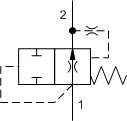
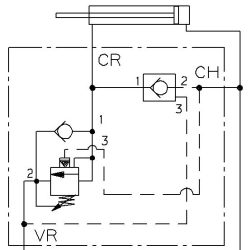
Always start with the schematic
The schematic is the initial phase where we find the best way to solve the function.
- The schematic becomes the common language between us and the customer to understand the application and function.
- You can isolate each function in the schematic, go deep, and truly choose the right variant of each valve.
- All parameters get a structured review.
- It’s an important support later in the process when reviewing the CAD design before manufacturing.
An important early question in the process is:
Should the schematic be optimized for cost, function, or lead time?
Valve placement
Valve placement is a very central part of the design. Here are a few tips and tricks.
- Adjustable valves should be easily accessible for users and service technicians.
- Non-adjustable valves can be placed more freely.
- The solenoid coil must always be removable – so extra space is required. Try to have solenoids point in the same direction so the manifold doesn’t “stick out” in different directions.
This often creates a trade-off:
Should the manifold be optimized for compactness – or for user-friendliness and ease of assembly?
It impacts the layout significantly. And on top of that – who doesn’t like a symmetrical manifold?
Rules for valve placement
There are rules and tables from SUN Hydraulics for:
- How close valves may be placed in a row
- Minimum center-to-center (C-C) spacing
- Minimum distance from a manifold surface, mounting surface, or raw surface
These are based on wall thickness, mounting distance, and any sleeves used.
Sensors and transducers
If electronic feedback is needed—either to control valves or as feedback to a control system—it is often beneficial to integrate pressure transducers and pressure sensors into the manifolds.
Wall thickness and basic guidelines
A guideline for wall thickness is never to design so that it drops below 5 mm. This includes extra margin and can be adjusted depending on several parameters, such as:
- Bore diameter
- One or two passages
- Passage placement
Construction drillings and cross-drillings
To reduce the number of construction drillings (and avoid external cross-drillings that must be plugged), you can work with internal angle drillings.
- Cross-drillings can be made as internal angle drillings instead of external drillings that must be plugged.
- SUN’s valve design—and therefore its cavities—makes it easier to create internal angle drillings.
- Side passages must hit the cartridges correctly.
- SUN Hydraulics ports are relatively large in diameter compared to industrial cavities, which simplifies the design.
Thanks to SUN Hydraulics having larger port intersections, there is more margin to hit correctly, the possibility of larger passages, and therefore lower pressure drop.
Test ports and diagnostic points
Test ports should be designed in from the beginning.
When the manifold is fully designed, it costs little to add test ports.
- You can leave a port with a threaded plug.
- Test points are placed strategically so you can measure key functions.
- They are important for troubleshooting, especially on new manifolds during machine commissioning.
- They can also be used for bleeding/venting.
Mounting solutions
The most common are tube-mounted or sandwich-mounted manifolds, but you can also design manifolds that:
- Mount using an O-ring interface directly on a flanged surface
- Mount on a motor or pump
- Mount with a banjo bolt on a cylinder
A flanged surface must be ground and have sufficiently good surface finish.
All ports are made with a recessed spotface and extra fine surface finish (Ra value).
Orifices and plugging
Orifices can easily be designed directly into the manifold.
- There are check valves with external pipe threads.
- We often choose to plug with an expansion plug.
- In some cases a threaded plug is preferred, but it takes more space.
Material selection and guidelines
A rule of thumb is that if pressure exceeds 210 bar, we choose steel. This is a general guideline related to fatigue. At 210 bar, aluminium does not withstand 1 million cycles without fatiguing to the point where it can become a risk. Constant pressure is significantly more gentle than pulsating pressure. Weight is also a factor in material selection.
Material selection:
- Aluminium 6065 or 7075, with or without anodizing
- Steel, with or without surface treatment. For surface treatment, we prefer zinc-nickel with 1000 h salt spray.
Manifold manufacturing
When the design is complete, reviewed by a colleague of the lead designer, and approved by the customer, the manifold goes into manufacturing. We have a large, well-established base of manifold manufacturers. Which manufacturer best suits the specific design is also a trade-off between:
- Material and any surface treatment
- Lead time requirements
- Cost
- MOQ quantity and annual volume
- Manufacturing complexity
- Manifold dimensions
SUN cavity tooling
If you are a company that machines materials, you will always get a good result in the cavity using SUN’s cavity tooling (pre-drill and reamer).
- You don’t need to dimension all diameters.
- What you need to consider is the pre-drill and LS depth.
- The tools are available to buy or rent.
If you have questions about manifold design, want design support, or need help manufacturing and assembling manifolds—just get in touch with us!