What is a logic element?
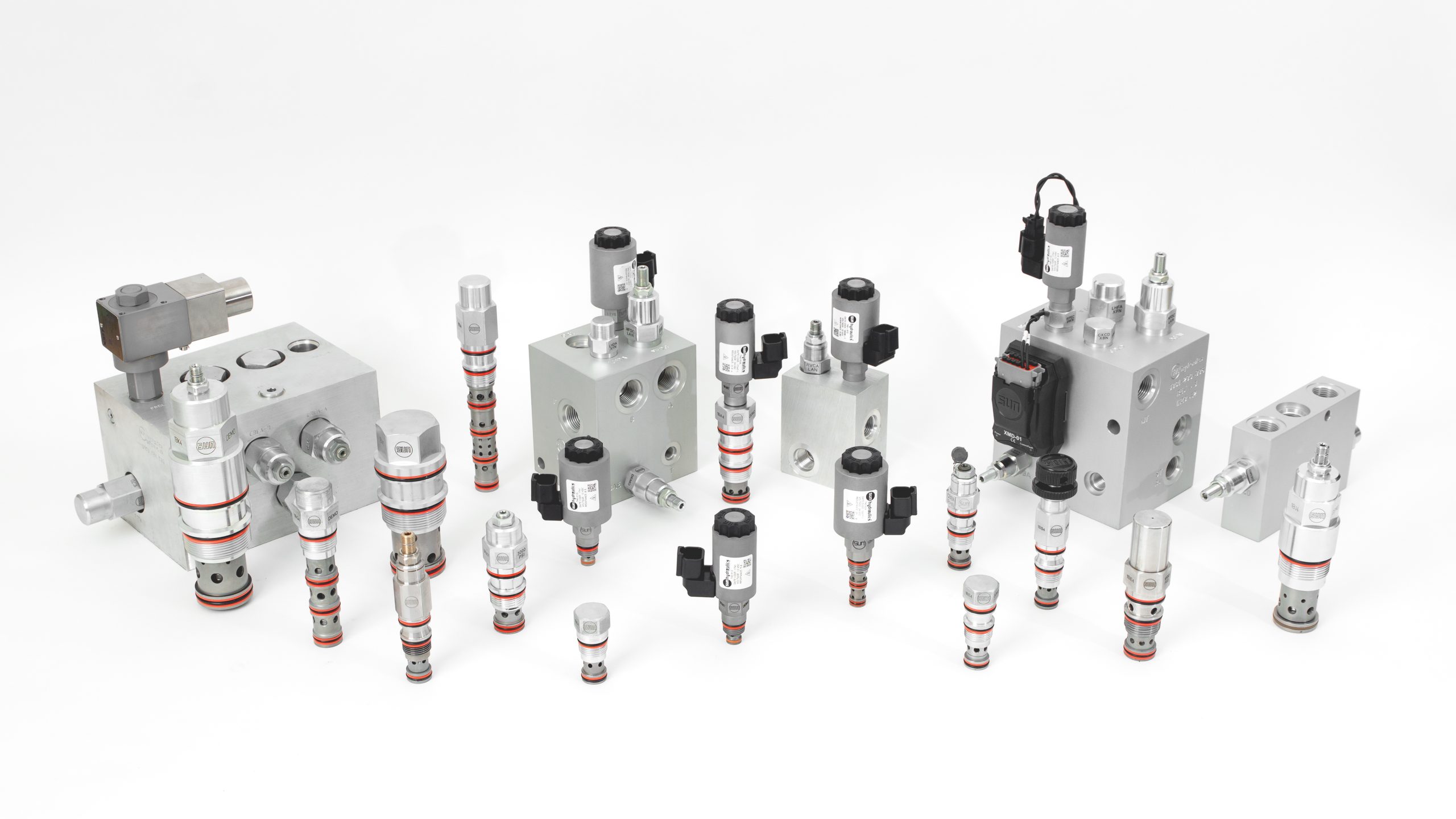
A logic element is a pilot-operated cartridge valve that opens or closes a main flow path by means of a small pilot signal. Think of it as the hydraulic equivalent of a relay output: a weak signal controls a large flow. This makes logic elements some of the most versatile building blocks in a hydraulic system – the same element can be used for directional control, unloading, sequencing or pressure compensation depending on how the pilot is connected.
How it works
The basic principle is simple: a poppet is held closed (or open) by a spring, and pilot pressure at the control port shifts the valve. In a normally closed switching element, the valve opens when pilot pressure overcomes the spring force, and reseats when the pilot pressure falls. Since the main stage is a poppet valve, leakage in the closed position is very low – typically less than 10 drops per minute at 350 bar (5000 psi) – which makes logic elements suitable even for load-holding functions.
Balanced or unbalanced?
The difference is decisive for how the valve behaves in the circuit:
- Unbalanced logic elements are affected by the pressure at the main ports. The opening characteristic then depends on both pilot pressure and system pressure – simpler, but less predictable.
- Balanced logic elements are hydraulically balanced between port 1 and port 2. The valve shifts predictably regardless of system pressure – up to 350 bar (5000 psi) at both main ports – and is controlled by the pilot pressure alone. Sun Hydraulics balanced elements shift with a minimum pilot pressure of approximately 30 bar (400 psi).
A practical detail: balanced and unbalanced elements of the same frame size often share the same cavity and can therefore be considered functional replacements in a rebuild – no new manifold machining required.
Vented versions – X and E
Three-port elements are available with an external atmospheric vent (control option X) or a static external drain (option E). The X version is often used as a problem solver in existing circuits, but the spring chamber is atmospherically referenced and may allow moisture in over time. For new designs, four-port valves or the E version are recommended, where the vent port is connected to drain. Incidentally, removing the vent plug converts an X element into an E element.
Common applications
- Directional control of large flows – a small pilot valve package controls elements in the main flow, more compact and economical than large spool valves.
- Unloading and fast venting – e.g. discharging an accumulator or rapidly lowering a load.
- Sequencing – the element opens only when pilot pressure reaches a set level.
- Pressure compensation – as the compensator stage in flow controls.
What to consider when selecting
- Flow capacity and cavity – choose the frame size according to the flow; Sun elements range from about 60 to more than 1,000 L/min.
- Minimum pilot pressure – verify that the control circuit can always deliver the pilot pressure required for reliable shifting.
- Leakage requirements – the tightness of the poppet design makes logic elements suitable where spool valves leak too much.
- Draining – decide early how the spring chamber should be drained (internally, externally, vented) – it determines both the function and which version to order.
Want to dive deeper into a specific element? All our logic elements have their own article pages with complete technical data – see for example DKDC, a normally closed balanced poppet-type element. And if you are unsure what suits your application, we are happy to help – get in touch, or ask Pascal right here on the site.